The Rise of ‘Nesting’ Divorces Explained by Northern Beaches Lawyers

family law solicitors Northern Beaches

Nesting is an arrangement where children stay in the family home full-time. Instead of kids moving between houses, the parents rotate in and out based on a set schedule. More parents are looking for ways to reduce upheaval. Nesting aims to protect children from sudden changes to their home, school, and routine during separation or divorce. 

No. Nesting is not a universal solution. It has clear benefits but also real challenges. Still, it is worth understanding as an option, especially with advice from experienced family law solicitors Northern Beaches families rely on. 

How Nesting Works 

Nesting can sound unusual at first. In practice, it follows a simple idea: the child’s life stays steady while the parents adjust around them. The details matter, and no two arrangements look exactly the same. 

At its core, nesting shifts the movement from the children to the parents. Schedules, boundaries, and clear rules support the arrangement. 

  • Children stay in one stable home 
  • Parents rotate through the family home 
  • Separate residences during “off” time 
  • Temporary or long-term 

The Benefits of Nesting  

Nesting appeals to parents who want to put children first without rushing major decisions. The advantages are often child-focused, but there can be benefits for parents too. Parents often choose nesting to reduce stress, avoid constant packing, and create breathing space during separation. 

  • Stability for children 

Children stay in a familiar home. Their school, friends, and activities remain unchanged. This consistency can support emotional wellbeing, especially in the early stages of separation. 

  • Less emotional disruption 

Moving homes every few days can be hard for children. Nesting removes that pressure. Kids are not asked to adapt to two bedrooms, two sets of rules, and two lifestyles all at once. 

  • Shared responsibility for the home 

Both parents continue to care for the family home. This can feel fairer and reinforce shared parenting responsibility. It may also help children see that both parents remain involved in daily life. 

  • No living out of suitcases 

Children keep their belongings where they belong. There is no need to remember which uniform, charger, or school book is at which house. This small detail can make a big difference. 

The Challenges of Nesting  

Despite its appeal, nesting is demanding. It requires maturity, trust, and strong communication. Without these, the arrangement can quickly break down. Nesting asks separated parents to stay connected in practical ways, even while emotionally moving apart. And the balance is not easy. 

  • Financial pressure 

Maintaining three residences is expensive. There is the family home plus at least one, sometimes two, additional living spaces. For many families, this cost alone makes nesting unrealistic. 

  • High level of cooperation required 

Nesting only works when parents communicate well. Schedules, expenses, repairs, and routines must be agreed on and respected. Ongoing conflict can undermine the arrangement. 

  • Boundary issues 

Sharing a home after separation can blur lines. Questions arise about privacy, personal items, and new relationships. Clear rules are essential to avoid resentment. 

  • Practical complications 

Who cleans? Who shops? What happens if one parent changes house rules? Even small issues can grow if expectations are not clear from the start. 

  • Emotional adjustment 

For some parents, nesting delays emotional separation. Coming and going from the former shared home can make it harder to accept that the relationship has ended. 

Is Nesting Right for Your Family? 

Nesting works best when it is a conscious choice, not a default. Honest assessment and professional guidance matter. Every family is different. What supports one child may strain another. Parents need to look at both emotional and practical realities. 

Nesting tends to work well where separations are amicable, finances are stable, and communication is respectful. Parents who can plan together and stick to agreements often manage nesting more successfully. 

It is not ideal for high-conflict separations, situations involving domestic violence, or limited financial resources are usually not suitable for nesting. In these cases, clear physical separation may better support safety and stability. 

Many family law solicitors Northern Beaches residents consult recommend nesting as a short-term measure. It can provide time to make informed decisions about property, parenting arrangements, and future housing. 

For the right family, nesting can be a valuable tool. It requires careful planning, written agreements, and sound legal advice. Speaking with experienced Northern Beaches lawyers can help clarify whether nesting suits your circumstances and how to structure it safely. 

If you are considering nesting or exploring other parenting arrangements, Doolan Callaghan can guide you through your options. Our team of family law solicitors Northern Beaches families trust can help you make decisions that support both your children and your future. 
Recognise the Need for Family Mediation in Northern Beaches

family mediation northern beaches

Have you ever hit a wall in your marriage? Conversations keep circling the same fight. Plans for the kids stall. Money talks turn into shouting matches. If this sounds familiar, it may be time to consider a different path: family mediation in Northern Beaches.

Mediation helps people find workable, private solutions without the stress of a courtroom. This guide explains five clear signs that professional mediation will help your family move forward — calmly, practically, and with dignity. 

5 Signs Family Mediation In Northern Beaches Will Help

Mediation won’t be right for every case. But when the signs below show up, a trained mediator can save time, money, and stress.

If several apply, pick up the phone and get advice. Doolan Callaghan lists mediation and dispute resolution as core services for Northern Beaches families. Read these short signals. Each one is a nudge toward a safer, faster way to resolve things.

  1. You Want Control Over The Outcome

Court decisions remove choice. Mediation hands choice back to you. Parties sit at the same table and shape the agreement together. This means parenting timetables, holidays, and financial splits can reflect your family’s real life — not a one-size-fits-all order.

The courts encourage parties to try dispute resolution first, where appropriate. It is usually faster and less costly than litigation. Family mediation in Northern Beaches helps with that.

  1. Communication Still Works — Even If It’s Fragile

If you and the other person can talk without the conversation collapsing, mediation is promising. You don’t need to be best friends. You just need to be able to sit, listen, and consider options.

Mediators shape the discussion and keep it respectful. They help reframe questions so negotiations don’t become rehashes of old hurts. When both people can engage, agreements are more durable, and kids feel the benefit. 

  1. Cost Is A Major Concern

Legal fees and court time add up fast. Mediation is generally more affordable. It usually takes fewer sessions than court proceedings and lets you avoid lengthy hearings. Agencies and private mediators offer flexible options — even online sessions — which can cut time and travel.

For families thinking about budgets, mediation is a sensible first step. The court system also recognises dispute resolution as a way to reduce cost and delay.

  1. You Want To Protect The Kids From Conflict

If children are involved, mediation often makes sense. A negotiated plan keeps parents involved and reduces the uncertainty that children feel during separation. Mediation lets parents design parenting arrangements that match daily routines, school needs, and support networks.

Where appropriate, mediators can use child-inclusive processes to consider the child’s voice safely. The Family Court and family support services stress that resolving matters out of court can reduce stress for children and parents.

  1. You Need Confidentiality And Privacy

Court files are public in different ways, and processes can be formal and exposed. Mediation sessions are confidential in most cases, which protects family information and sensitive details. That privacy often allows people to speak more openly and reach practical solutions. Many families choose mediation specifically to keep negotiations private and to avoid the public nature of court hearings.

Be Prepared

If one or more of those signs hit home, mediation could save you months of stress. Below are quick, practical tips for getting ready — and what to expect when you walk into a mediation room on the Northern Beaches.

  • Write a short list of must-haves and nice-to-haves. Keep it visible during talks.
  • Gather key documents: income evidence, school details for kids, and any urgent orders.
  • Decide who will speak for you and when you’ll pause if emotions spike.
  • Consider legal advice before or after mediation so you understand the legal shape of any agreement.
  • Bring a calm, realistic mindset. Mediation rewards flexibility more than stubbornness.

What Happens In A Session

A mediator opens the meeting with ground rules. Each person describes their priorities. The mediator helps translate positions into options. You’ll test solutions and trade small concessions for bigger wins. If you reach an agreement, mediators usually help turn it into a signed document or consent orders you can take to court. If you don’t reach a full agreement, the session still often narrows points and prevents escalation.

Find Common Ground Through Family Mediation in Northern Beaches

Mediation works when people want practical answers, privacy and a faster path than court. If you recognise these five signs — wanting control, workable communication, cost concerns, child-centred thinking, and a need for privacy — consider professional family mediation in Northern Beaches.

Doolan Callaghan offers family mediation services and specialist family law support on the Northern Beaches and North Shore, including options to discuss your situation with the team. We make mediation and dispute resolution part of the local offering for families who want sensible outcomes.

Ready to try a calm, practical route? Book a free, confidential 15-minute chat so you can explain your situation and learn your options. Reach out to see if mediation fits your family’s needs.

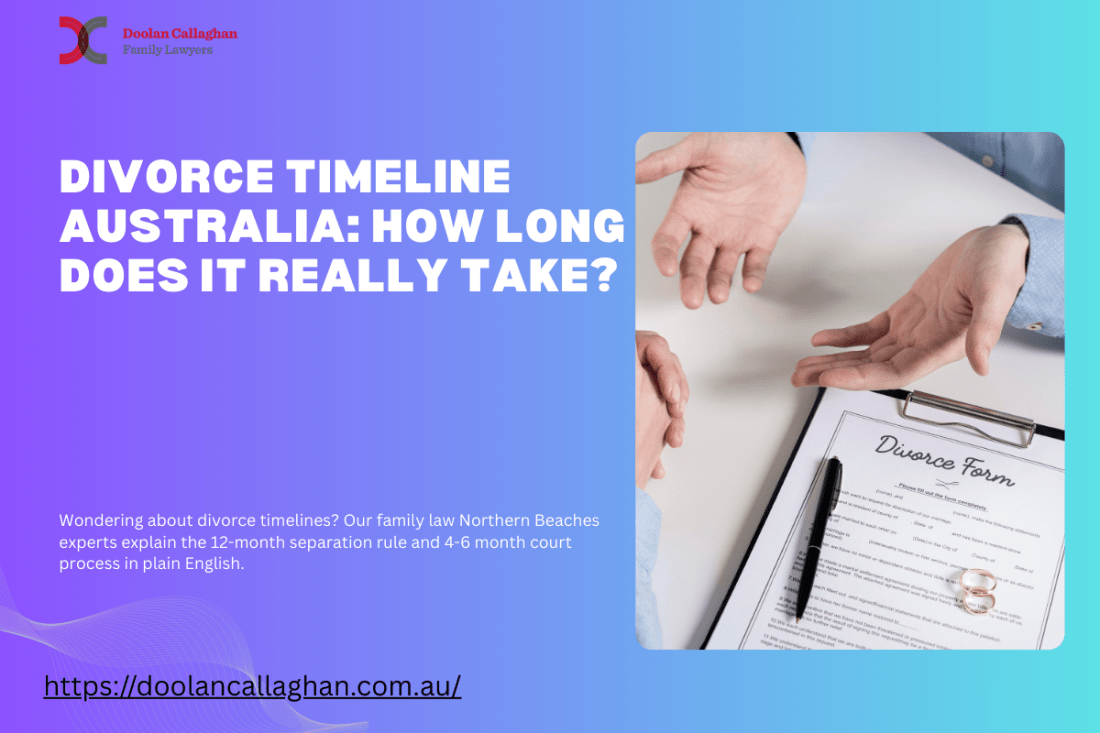
How Long Does a Divorce Actually Take in Australia?

divorce lawyers Northern Beaches

Divorce in Australia follows a clear legal pathway, but it is rarely quick. Many people are surprised by how much waiting is built into the process. Knowing the timeline early can help you plan and reduce stress. 

You must be separated for at least 12 months before you can apply for a divorce. From filing the application to finalisation, divorce usually takes another 4 to 6 months. 

The 12-Month Separation Requirement 

Australian divorce law is based on no-fault principles. The court does not look at why the marriage ended. It only checks whether the relationship has broken down beyond repair. 

  • Mandatory separation period 

You must live separately for a full 12 months before applying. This period must be continuous. Short attempts at reconciliation can reset the clock if they last more than three months. 

  • Separation under one roof 

You can still be considered separated while living in the same home. This often happens for financial or parenting reasons. Extra evidence is required, such as affidavits showing separate lives and arrangements. 

  • No exceptions 

There are no shortcuts. Even in difficult situations, the court cannot waive this rule. This is a key area where advice from a practitioner experienced in family law Northern Beaches matters can help avoid delays. 

Application Process (1–2 Months) 

Once the separation period ends, the formal process begins. This stage is mostly administrative but needs care and accuracy. 

  • Joint vs sole application 

A joint application means both parties apply together. This is often smoother and avoids service issues. A sole application is lodged by one party and requires formal service on the other. 

  • Required documents 

You will need your marriage certificate. If it is not in English, a translation is required. Proof of Australian citizenship or residency is also necessary. 

  • Filing with the court 

Applications are lodged with the Federal Circuit and Family Court of Australia. Most filings are done online. 

  • Filing fees 

A court filing fee applies, though reductions may be available in some cases. A family lawyer Northern Beaches can guide you on eligibility and correct filing. 

Waiting for Your Court Date (2–3 Months) 

After filing, the application enters the court system. This is where patience is required. 

  • Court scheduling 

The court allocates a hearing date based on availability. Timeframes vary depending on location and workload. 

  • If your spouse contests 

If the divorce is opposed, the process can slow down. Extra documents and hearings may be required, extending the timeline. 

  • Service rules 

For sole applications, strict service rules apply. If service is delayed or disputed, the hearing may be adjourned. This is a common issue seen by divorce lawyers on the Northern Beaches. 

The Court Hearing 

Most divorce hearings are straightforward. The court’s role is limited and practical. 

  • Paper-based process 

In many cases, no one attends court. The application is reviewed on the papers, especially for joint applications without children under 18. 

  • When attendance is required 

You may need to attend if there are children under 18 and a sole application, or if the court needs clarification. 

  • What the court checks 

The court confirms separation, jurisdiction, service, and proper arrangements for children. It does not decide property or parenting disputes. 

After the Divorce Order (1 Month) 

The divorce order is not final straight away. There is a built-in pause. 

  • Finalisation period 

The divorce becomes final one month and one day after the order is made. 

  • Reason for the wait 

This period allows time for appeals in rare cases. It also gives clarity and finality before remarriage. 

  • What you can and cannot do 

You cannot remarry until the divorce is final. You can, however, continue negotiations about property and parenting. 

Total Timeline: The Reality 

When all stages are added together, divorce is not fast. Understanding the full picture helps set realistic expectations. 

A simple divorce usually takes 16 to 18 months in total. This includes 12 months of separation and 4 to 6 months of processing. 

If there are disputes, service issues, or missing documents, it can take much longer. These delays often arise without early legal advice. 

  • What affects speed 

Clear separation dates, joint applications, and proper documents speed things up. Conflict, poor communication, and errors slow them down. This is where experienced divorce lawyers Northern Beaches add value. 

Property Settlement & Parenting Orders 

Divorce is only one part of the legal picture. Many people confuse it with other family law issues. 

  • Separate legal processes 

Divorce is separate from property division and parenting arrangements. You do not need a divorce to start these matters. 

  • Timing matters 

Property and parenting issues often take longer than the divorce itself. They are best handled before or during the divorce process. 

  • Key deadline 

You have 12 months after your divorce is final to apply for property settlement. Missing this deadline can create serious legal hurdles, which is why family law Northern Beaches advice is crucial. 

In most cases, expect a minimum of 16 months from separation to a finalised divorce. While divorce can be simple on paper, mistakes cause delays. Complex situations benefit from early legal advice. 

For clear, practical guidance, contact Doolan Callaghan. Our team understands the realities of family law Northern Beaches and can help you move forward with confidence. 

Why Many Northern Beaches Startups Fail to Protect Their First Big Idea

law firm on the Northern Beaches

Talking to a law firm on the Northern Beaches might feel premature when you’re still sketching your first concept. But here’s a scenario that plays out too often. A founder shares an idea over coffee in Manly. Three months later, a similar brand pops up with nearly identical branding. The coastal startup scene moves fast, and small industries mean word travels even faster. Your idea is more exposed than you think. In communities where everyone seems to know everyone, early protection isn’t optional. It’s survival.

The Northern Beaches Startup Scene Is Fast, but Legally Unprepared

The stretch from Manly to Dee Why has become a hotspot for micro brands. Surf gear labels, wellness startups, artisan food makers, small tech teams. They all share something in common. A collaborative spirit that fuels creativity and growth. Founders meet at cafés and coworking spaces, swap notes, and build together. That’s the magic. But it’s also the risk.

Verbal promises replace contracts. Handshakes stand in for agreements. And when things go wrong, there’s nothing on paper to fall back on. I’ve seen two Manly founders share prototype details before either thought to register a thing. It happens more than you’d expect. The energy here is incredible, but the legal gaps are very real.

The Biggest Reason Startups Lose Their First Idea: No Early IP Strategy

Most founders think they’re too early to worry about intellectual property. “I’ll deal with that later,” they say. Then later becomes never, until someone else beats them to it.

Northern Beaches lawyers see this pattern constantly. Copyright, trademarks, trade secrets, and domain names. These aren’t just legal terms. They’re the walls around your idea. Without them, anyone can walk in. A Brookvale fitness brand learned this the hard way. They soft launched on Instagram, built a following, and then discovered another company had already trademarked their name. Months of work, gone.

Coastal lifestyle markets move at a brutal pace. Wellness brands, surf labels, boutique food makers, they all compete for attention in a crowded space. If you wait too long to protect your name or product, someone else might grab it. Thinking you’re too small? That’s exactly when protection matters most.

Local Pitfalls That Expose Founders Even Faster

Coworking hubs in Manly and Dee Why are great for connection. They’re also places where ideas spread fast. Oversharing happens. You chat with a fellow founder, describe your prototype, and suddenly that concept isn’t quite so secret anymore.

It gets trickier. Early collaborations with surf photographers, designers, or fabricators often happen without contracts. Startup meetups and beachside networking sessions encourage founders to pitch freely. But a law firm on the Northern Beaches often hears the same story. A wellness product gets discussed at a meetup, and within months, a similar version appears on the market.

Small industry clusters mean word travels. A designer talks to a friend. That friend mentions it to someone else. Soon, your idea has legs you didn’t give it. The collaborative culture is a gift, but only if you protect what matters before you share it.

Simple Legal Tools That Prevent Idea Loss (And Cost Less Than You Think)

You don’t need a massive budget to protect your idea. A few small moves early on can save you from expensive disputes down the road. Really.

  • NDAs before sharing prototypes or pitches
  • Trademark registration for your name and key product lines
  • Founders’ agreements to protect equity and rights
  • IP audits for early products, packaging, and branding

Northern Beaches lawyers often remind clients that NSW has clear intellectual property enforcement options for small businesses. But you need the paperwork in place first. Proactive steps cost a fraction of what legal battles do later.

Here’s a quick win story. A Narrabeen startup secured its trademark early. When a Melbourne competitor tried to use a similar name, they had documentation ready. The issue was resolved without a court. No drama. No lost momentum. Just smooth sailing.

Think of it like insurance. You hope you never need it, but you’ll be glad it’s there if trouble shows up at your door.

When to Talk to a Northern Beaches Lawyer About Your Idea

Timing matters more than most founders realise. The best time to get advice isn’t after you launch. It’s before. Simple as that.

  • Before collaborating with designers, suppliers, or manufacturers
  • Before announcing on social platforms
  • When registering domains, social handles, or business names
  • When pitching to investors, even informal local angel networks

And if you spot a competitor using similar branding? That’s an immediate red flag. Don’t wait.

Most founders delay legal advice by six to twelve months. By then, the damage is often done. A short conversation early on can prevent months of stress later. Your idea deserves that head start, and getting advice now costs far less than fixing problems after.

Coastal markets move fast. Ideas spread faster. If you’re building something on the Northern Beaches, protection can’t wait until after launch. The founders who thrive are often the ones who locked down their IP before anyone else had the chance to copy it. A quick early review might be the smartest move you make.

Northern Beaches Lawyers’ Pre-Separation Checklist: 10 Things to Do First

northern beaches lawyers

If you’re thinking about separating, start with clear steps now. Don’t just move out. Make clear plans before you take any steps. This is what the Northern Beaches lawyers recommend.

Early action reduces stress and protects your position. This guide gives ten practical things to do first. It focuses on finances, documents, and assets. You learn how to set up separate living arrangements. Read each item and act on what applies to you.

The Pre-Separation Checklist As Suggested by Northern Beaches Lawyers

Before you separate, take practical steps. Protect yourself and your family. Northern Beaches lawyers recommend preparing documents and securing finances. Think through living arrangements before any permanent moves.

Start with a short legal consultation and compile a clear list of assets, debts, and important records. Keep communications calm. You must prioritise children’s stability and make safety your first concern. Read the checklist below for ten focused steps to help you begin the process with clarity and control. Start reading now.

  1. Talk to a Family Lawyer Early

Get a short legal briefing. Do this as fast as you can. A 15-minute, confidential chat can clarify options. It makes taking the next steps so much easier. Ask what evidence matters and how leaving the home may affect property and parenting rights. Most professional firms offer an initial confidential chat to help you start.

Early advice prevents mistakes. It helps you plan a calm, practical route forward.

  1. Make a Clear List of Assets and Debts

Write down everything you own. Also, make a list of what you owe. Include houses, cars, superannuation, bank accounts, credit cards, loans, and business interests. Note who holds each account and any joint arrangements.

Use a simple spreadsheet to do this. Add current values and approximate dates of purchase. This snapshot speeds up later negotiations or applications.

  1. Gather Key Documents Now

Collect identity documents, bank statements, mortgage papers, tax returns, payslips, super statements, and title deeds. Also, save contracts, trust records, and any communications about money or property.

Download at least 12 months of statements from online banking. Save PDFs in a folder you control. If you cannot access shared accounts, note the account numbers and institutions.

  1. Separate Finances Where Possible — Safely

Open a personal bank account in your name. Redirect a portion of income if practicable. Keep some accessible savings for essentials. Avoid hiding money or draining joint accounts. This can backfire in court.

A practical tip is to set up internet banking. You can also use a separate email for financial communications. Keep a modest buffer for rent, food, and bills.

  1. Take a Financial “Snapshot” with Dated Evidence

Record balances, investments, and the value of physical items on a specific date. Take screenshots or photos showing the date and balance. Keep copies in two secure places. Courts and mediators look for accurate pictures of the financial position around separation. A dated snapshot strengthens your credibility.

  1. Protect High-Value Assets and Business Interests

If you own a business, document its structure. Make sure to note its income and assets too. Get professional valuations only when advised by your lawyer. Consider freezing major transactions until you have legal advice.

Making major transfers, selling assets, or suddenly paying relatives can be treated as suspicious and adjusted later. Get legal input before changing ownership or moving significant funds.

  1. Sort Living Arrangements and Logistics

Decide who will stay in the family home and who will leave. Only do this if it is safe to do so. If children are involved, focus on stability. If you must move out, line up temporary housing, childcare, and transport.

Pack personal documents, children’s essentials, and medications. Also, make sure you have at least one month of clothing. Keep keys and records of any property handed over.

  1. Think about Parenting and Communications

Plan conversations with children that are age-appropriate and calm. Avoid blaming the other parent in front of them. If possible, agree on temporary care arrangements and school logistics before separation.

Keep a neutral log of important parenting events, pick-ups, school notes, and any disagreements. This can help if parenting arrangements become contested.

  1. Review Wills, Powers of Attorney, and Insurance Beneficiaries

Check your will. Review any appointed powers of attorney as well. Confirm who your life insurance and superannuation nominations name as beneficiaries. Update these documents only after legal advice, especially if property division or support claims are likely.

These documents affect long-term outcomes and can create future complications if left unchanged or altered impulsively.

  1. Prioritise Safety and get Support if You Need It

If there is any history of family violence or you feel unsafe, seek immediate help. Contact NSW Police in emergencies and reach out to local support services. A lawyer can advise on urgent protection orders and safe housing options.

Keep emergency contacts and a bag ready. Take photos of injuries or threatening communications and store them securely.

Conclusion and CTA to Doolan Callaghan

Separation is hard. Being prepared makes it easier to protect your finances, your children, and your peace of mind. Northern Beaches lawyers advise practical, measured steps. Get advice early, gather documents, separate essential finances, and keep safety front of mind.

If you want a clear next step, Doolan Callaghan can help with a confidential initial chat and tailored guidance for Northern Beaches residents. Doolan Callaghan is a specialist family law firm serving the Northern Beaches and North Shore. We help with separation, property, children, and mediation.

If you’d like, contact Doolan Callaghan to arrange that first conversation. We can outline immediate actions and explain your options in plain language

How to Prepare for Your First Meeting With Northern Beaches Lawyers

solicitors northern beaches sydney

Meeting solicitors on the Northern Beaches, Sydney, for the first time can feel like a lot. You may be walking into an office in Manly or Brookvale with your whole story in your head and no idea where to start. That uneasy feeling grows when you are worried about children, money, or where you are going to live next.

The simple fix is preparation. A bit of planning can turn a stressful meeting into a structured chat where you leave with clearer options. It does not need to be perfect. It just needs to be honest and organised enough to give the lawyer a fair picture of your life.

What You Should Bring to Your First Consultation

Bring the basics. Having the right material with you means the meeting can move from guesswork to concrete advice much more quickly. You do not need a perfect folder, but a simple stack or envelope already helps.

Personal Identification & Basic Details

Start with simple identity and contact information.

  • Bring a photo ID
    • Use a driver’s licence, passport, or proof of age card
  • Write down contact details
    • List both parties’ phone numbers and email addresses
  • Note key dates
    • Record the start of the relationship, separation, and the children’s dates of birth

Financial Documents

Money issues often take up a big part of family law advice, so some basic records are useful.

  • Gather bank statements
    • Include joint and personal accounts for the last three to six months
  • Bring loan and credit details
    • Print mortgage, personal loan, and credit card statements
  • Collect property and super papers
    • Rates notices, title information, superannuation statements, and any financial agreement

Relevant Communication Records

Old messages can be very useful when recalling what was said and when.

  • Save important texts and emails
    • Screenshots or printouts of key exchanges about children or money
  • Note major events
    • Short notes about big arguments, moves, or agreements
  • Bring any written parenting schedules
    • Even if it is just a shared calendar showing who has the kids and when

Court or Legal Documents (If Applicable)

If anything has already gone formal, bring it along.

  • Pack any court orders
    • Parenting orders, safety orders, or previous property orders
  • Include past legal letters
    • Correspondence from earlier lawyers or mediation services
  • Add filed applications
    • Copies of any documents already submitted to the court registry

Bringing organised paperwork helps Northern Beaches lawyers start with real information instead of guesswork.

How to Organise Your Story Clearly Before the Meeting

A clear story lowers the temperature. When the situation is emotional, structure becomes your friend. It keeps the meeting from turning into a re run of every argument.

Write a Short Timeline of Events

Keep it simple. Use a page or a digital note to write a short timeline. Start with when you met, moved in together, had children, bought a property, and then when you separated. Include a handful of important points after separation, such as serious disputes or temporary agreements.

This kind of timeline gives solicitors on the Northern Beaches, Sydney, a clean overview before they dive into detail.

List Your Main Concerns or Questions

Your worries matter. Before the meeting, jot down the three to seven things keeping you awake at night. Then turn those worries into questions.

  • Write questions about parenting
    • How might time with the children be shared
    • What happens with school holidays and sports
  • Write questions about the property
    • What usually happens to the home or investment unit
    • How debts and savings are looked at
  • Write questions about safety and short term money
    • What to do if you feel unsafe
    • Whether temporary financial support is realistic

Identify Your Desired Outcomes

On second thought, this part is more important than it first looks.

Try to write out three sets of outcomes: what you would like to see, what you could live with, and what feels completely unacceptable. For example, you might want close to equal time with the children, but could accept less during the school term if holidays are longer.

A structured story like this helps solicitors on the Northern Beaches Sydney, understand your situation without needing to drag every detail out of you.

Prepare for Honest, Direct Questions

Family law advice often needs quite personal detail. There may be questions about arguments, mental health, past use of alcohol, or parenting choices. That can feel uncomfortable at first.

The point is not to embarrass you. The point is to let Northern Beaches lawyers see the risks and strengths in your situation so they can give realistic guidance.

Many people say they walk out feeling lighter simply because they have finally said everything out loud.

What Solicitors on the Northern Beaches, Sydney, Will Do in the First Consultation

It helps to know what the lawyer is doing on their side of the table.

During that first meeting, they are usually trying to build a quick mental map of your life. They listen to your timeline, scan the documents, and ask follow up questions to fill gaps.

In many matters, they will

  • Spot any urgent risk issues and suggest immediate steps
  • Identify whether parenting, property, or safety is the main driver
  • Outline broad pathways like mediation, negotiation, or court proceedings

Some lawyers also discuss local practicalities, such as how handovers at school might work or what to expect if your matter ends up listed in the city rather than closer to home.

By the end, you may leave with a short action list for the next few weeks. That could include gathering extra documents, contacting services, or speaking carefully with the other parent about a temporary arrangement.

The first consultation is less about solving everything and more about setting a steady direction.

A good first consultation with solicitors Northern Beaches Sydney, should leave you clearer about where you stand, even if there is still a long way to go.

Conclusion

Preparing for a first legal meeting does not need to be complicated. With a few notes, the right documents, and some emotional planning, you give yourself space to think rather than just react.

Every family story on the Northern Beaches has its own mix of history, stress, and hope. Your preparation simply helps that story come across more clearly when you sit in the chair across from the lawyer.

Think about what feels steady and healthy for you and your children, and take the next small step that fits that picture.

Avoiding the courtroom: mediation strategies in family law on the Northern Beaches

Doolan Callaghan family lawyers

If you’re facing separation from your spouse on the Northern Beaches and dreading court, discover how mediation can protect your children, finances and peace of mind, with insights from Doolan Callaghan family lawyers.

Why choose mediation in family law on the Northern Beaches?

When a relationship breaks down, it is easy to assume court is the “serious” option. In reality, mediation often resolves family law on the Northern Beaches faster, with less damage to your finances and your family.

The court involves formal hearings, strict rules and long delays. Mediation keeps the process private and flexible. You sit down with support, outline the issues and work through options that fit your actual lives, not a judge’s brief snapshot of them.

The local context matters. Northern Beaches homes often carry beachside premiums. Arguments over whether to sell or keep the family home can quickly escalate into costly litigation. Mediation lets you talk about these big-ticket items early and design practical solutions before positions harden.

Mediation vs court in simple terms:

  • Mediation: lower cost, usually faster, child-focused, more control.
  • Court: more formal, higher cost, slower, stricter outcomes.

The common mistake? Believing the court automatically gives the “stronger” outcome, when it often just increases stress, cost and delay.

The cost and emotional toll of court-based litigation

Litigation usually means higher legal fees, repeated court dates and months of uncertainty. Children pick up on the conflict. Parents stay stuck in anger instead of planning the next chapter. Mediation aims to shorten that painful period.

How specialist family law on the Northern Beaches changes the dynamic

Specialist firms dealing with family law on the Northern Beaches understand local property values, school catchments and community expectations. That local knowledge leads to more realistic proposals and fewer arguments over what is actually possible.

Local context: community-based, specialist firms such as Doolan Callaghan

A community-based firm can connect you with local mediators, psychologists, valuers and child-focused services. You are not dealing with strangers who do not understand the area where your children live, go to school and play sports.

Understanding the mediation process with Doolan Callaghan Family Lawyers

A common fear is, “What actually happens in mediation?” family mediation northern beaches use a clear structure, so you always know what comes next and why it matters.

Initial consultation: what to expect and how to prepare

In the first meeting, your lawyer listens to your story, safety concerns and goals. You talk about children, property and any urgent issues such as cash flow or who remains in the home.

Helpful preparation:

  • Recent bank statements and mortgage details
  • A simple list of assets and debts
  • Any current parenting arrangements

Your lawyer then explains your options and whether mediation should start now or after more disclosure, valuations or risk assessments.

The mediator’s role vs your lawyer’s role

The mediator is neutral. Their job is to manage the discussion, keep it respectful and help both of you explore options. They do not “take sides.”

Your lawyer is firmly on your side. They:

  • Explain your legal position in plain language
  • Help you decide what offers to accept or reject
  • Speak for you if you feel overwhelmed

That mix of neutral mediator and supportive lawyer keeps the process fair without turning it into a courtroom.

Timeline and key steps: from briefing to agreement

After preparation, mediation usually runs for half a day or a full day. You might sit together or in separate rooms, with the mediator moving between you. If you reach an agreement, your lawyer turns it into binding court orders or a financial agreement so everyone knows exactly where they stand.

Key strategies for a successful mediation in family law

Mediation works best when you treat it as focused problem-solving, not a casual chat about family law on the Northern Beaches.

1. Preparing your case: knowing your priorities, facts and emotions

Before the day, write down your priorities. Time with the children, keeping the home, reducing debt, or achieving a clean break—rank what matters most. Notice your emotions, but commit to decisions that will still make sense in five years.

2. Communication strategy: staying constructive, managing children’s interests

Blame rarely helps. Shift language from “You always…” to “What will work best for the kids?” Think about school runs, sport, friendships and housing. A child-focused plan usually lands better with the other parent and with any court that later reviews your agreement.

3. Financial clarity: asset disclosure, property on the Northern Beaches context

Full financial disclosure is non-negotiable. List all accounts, loans, superannuation, businesses and any Northern Beaches property. With local prices often high and variable, formal valuations can prevent arguments based on guesswork.

When to call in specialists

You might need valuers for real estate, forensic accountants for complex structures or parenting experts where there are safety or development concerns. Calling in the right specialist at the right time can support fair outcomes without abandoning mediation.

Early settlement vs “perfect” disclosure? 

Waiting for every last document can delay progress and increase legal spend. The risk is overspending while everyone, especially the children, remains in limbo. Your lawyer can help you judge when you have enough information to settle safely.

Common hurdles in mediation and how to overcome them

Even with strong preparation, mediations can hit roadblocks. solicitors northern beaches sydney pay close attention to these patterns and help you respond.

One party resisting mediation or using it as a stalling tactic

Sometimes a person attends mediation to “tick the box” but refuses to move. Firm agendas, time limits and clear follow-up options stop the process from becoming a stall tactic. If offers never shift, your lawyer will discuss the next steps, including court, where necessary.

Power imbalances (financial, emotional, parenting)

Where there is financial control, emotional pressure or family violence, mediation needs careful design. Tools include separate rooms, support people, shorter sessions and strong legal backing. In some situations, your lawyer may advise skipping mediation entirely and using the court to secure safety and structure.

When mediation fails: recognising when court might be necessary

Mediation does not need to fix everything to be worthwhile. Even partial agreement narrows what a court must decide. If key issues remain stuck, often safety or complex finances, the court becomes the backup plan rather than a failure.

How to choose your family law partner on the Northern Beaches

Your choice of lawyer shapes your experience of northern beaches lawyers. Look for:

  • Accredited family law specialists
  • Strong mediation and negotiation skills
  • Genuine local experience with Northern Beaches property and parenting issues

Compare options:

  • DIY or generic online service: cheaper upfront, but limited strategy and local insight.
  • Specialist local firm: higher expertise and clearer guidance, often fewer court days in the long run.

Ask at your first meeting: “How will you use mediation in my case?” “What happens if we still need court later?”

Take-away action steps to move forward

You do not need everything perfect to start.

  1. Gather recent bank statements, mortgage and loan details, super information and any parenting notes.
  2. List your main issues and your first ideas for solutions.
  3. Book an initial consultation with a specialist family lawyer on the Northern Beaches.

You should walk away from that meeting with a clear picture of whether mediation suits your situation now, what preparation comes next and what your Plan B looks like if mediation does not resolve everything.

7 Ways Northern Beaches Lawyers Resolve Divorce Struggles 

Northern Beaches Lawyers

Divorce is not always easy, especially when feelings run high and there are difficult legal fights. You may feel stressed, exhausted, or even lost about your rights and next steps if you are going through a divorce. Good news, though: divorce lawyers in the Northern Beaches know how to strike a mix between providing mental support and giving good legal advice. They know the unique stresses you are under, like not having enough money, fighting over child custody, or dividing large assets, and they have made strategies that work best in various places including the lively towns along Sydney’s beautiful Northern Beaches.

Personalized Approach Tailored to You

Divorces do not always look the same. Thank goodness, Northern Beaches lawyers really get this. They take the time to learn about your specific situation, such as your age, assets, and family relationships, and then they offer custom solutions instead of one-size-fits-all answers. These professionals make personalised plans for each client, from young adults going through early marriage breakdowns to retirees figuring out decades of financial planning. Empathy is just as important as knowledge when it comes to making sure that every step takes your mental and physical needs into account.

Resolving Custody Disputes Smoothly

Disputes over child rights are often the most painful parts of getting a divorce. Families on the Northern Beaches usually try to be friendly and focus on their children as family peace is of utmost importance. Lawyers with a lot of experience use mediation to help parents work together and understand each other better. Instead of letting disagreements drag on, these professionals use clear communication, negotiation, and organised mediation to make things much less stressful and keep the mental health of children at the centre of everything they do.

Navigating Complex Financial Situations Effectively

You know how quickly things can get confusing when there are a lot of money at stake in the breakup. Divorce lawyers in the Northern Beaches are very good at getting to the bottom of complicated financial situations. Their knowledge of the area is very helpful, whether it is for family businesses in Manly, high-value real estate in Palm Beach, or retirement plans built up over many years. These lawyers protect your financial future so you can safely move on to the next step. They are skilled at figuring out how much a property is worth, dividing investments, and making sure that everyone gets a fair deal.

Offering Affordable Legal Options for All Backgrounds

Not everyone who is getting a divorce has a lot of money to spend. But does this mean that no one can get good legal help? Without a doubt not. When people are having trouble with money, Northern Beaches lawyers offer creative, low-cost options. No one feels like they can not get good legal assistance thanks to legal centres and flexible payment plans. After all, money worries should not add to the stress of getting a divorce, right?

Expert Mediation to Reduce Conflict

Legal fees and mental tolls can go up a lot when there is a lot of strife. Luckily, divorce lawyers on the Northern Beaches are experts in mediation techniques that help people talk things out without too much conflict. They know the local cultural norms about how to deal with others in the community and with family. This helps people talk things out so that they can come to an understanding instead of fighting in court.

Navigating Gender-Specific Challenges

In a divorce, both men and women face different problems, such as differences in pay and biases in child custody arrangements. Northern Beaches lawyers have witnessed and handled everything. Their aggressive method deals with gender-related issues head-on, making sure that everyone is treated equally, no matter their gender. Years of experience with local cases have given them the skills to effectively and carefully represent both fathers seeking fair custody terms and moms protecting their financial security. It makes you wonder why someone would go through these rough seas by themselves.

Comprehensive Asset Division Strategies

Dividing assets is one of the hardest parts of getting a divorce, especially in places like the Northern Beaches where property prices change a lot and the stakes can feel very high. Thankfully, these skilled lawyers carefully split complicated assets in a fair way. By carefully assessing beachfront homes and arranging business ownership stakes, they protect your financial future and make sure you are in a good place after the split.

Providing Emotional Intelligence and Support

Let us face it: getting a divorce is both hard and necessary. Experienced lawyers are both smart about the law and good at understanding people. They listen to your thoughts and help you make smart choices. They are your confidant, guide, and champion. By giving you mental support, they help you stay calm, which makes the whole process go more smoothly and with less worry.

Conclusion

Picking the right legal partner is very important when it comes to getting a divorce. Northern Beaches lawyers do not just give legal help; they also offer peace of mind, compassionate understanding, and strategies that are tailor-made for your particular situation. So why fight alone when you can call for personalised, professional help? Reach out today to take back control of the next part of your life.